
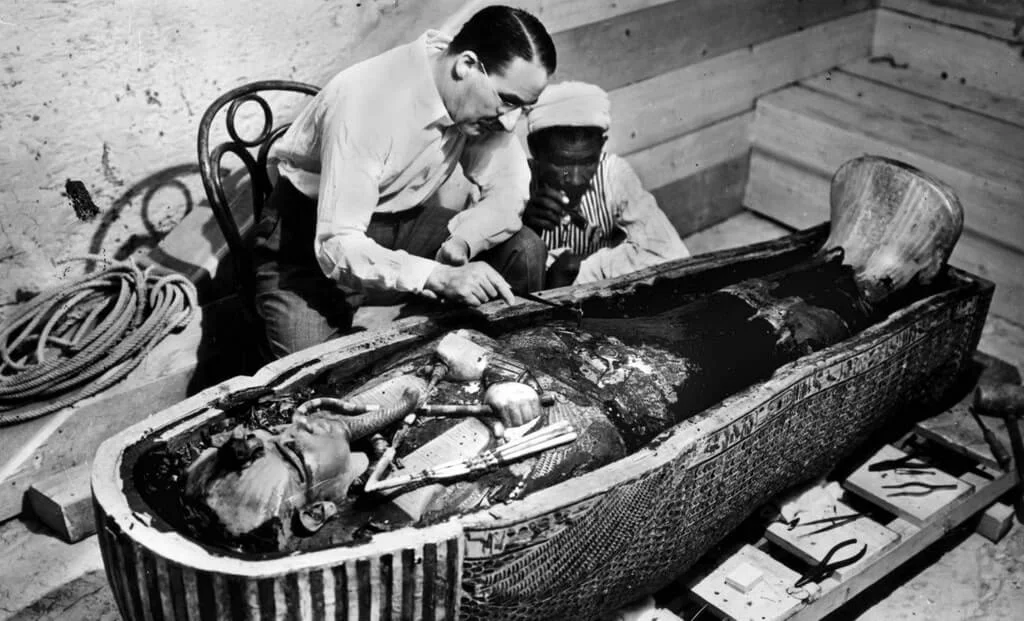
Howard Carter was a British archaeologist and Egyptologist, best known for his discovery of the intact tomb of Pharaoh Tutankhamun in 1922. The youngest of eleven children, Carter had limited formal education but showed a strong artistic talent, which his father, a successful artist, nurtured. This artistic skill became his entry point into the world of Egyptology.
Early Career and Excavations
At age 17, Carter’s artistic abilities earned him a position as a draughtsman for the Egypt Exploration Fund (EEF) in 1891. Specifically, his job was to meticulously copy tomb and temple wall reliefs, a skill for which he became well-known. During this time, he worked at sites like Beni Hasan and the temple of Hatshepsut at Deir el-Bahari. Afterward, in 1899, he was appointed Inspector of Monuments for Upper Egypt for the Egyptian Antiquities Service.
In this role, he supervised excavations and developed a grid-block system for searching for tombs. However, his career with the service ended in 1905 after a dispute with French tourists. Consequently, for a few years, he made a living by painting and selling watercolors to tourists.
The Search for Tutankhamun
In 1907, Carter began working for Lord Carnarvon, a wealthy aristocrat who wanted to finance an archaeological expedition. Carter persuaded Carnarvon to fund a search for the tomb of the little-known pharaoh, Tutankhamun. They were confident that the tomb lay somewhere in the Valley of the Kings, an area that had been heavily excavated for decades. For five years, they searched with little success. Lord Carnarvon became frustrated and was ready to withdraw his funding. Carter, however, persuaded him to finance one last season. On November 4, 1922, a worker stumbled upon a stone step under the remains of ancient workers’ huts. This led to a staircase and, eventually, a sealed doorway bearing the name of Tutankhamun.
The Discovery and Legacy
Howard Carter and the Tomb of Tutankhamun This video provides a short historical documentary about Howard Carter’s life and his famous discovery of Tutankhamun’s tomb. Contact us.